
Market Intelligence: How to Turn Market Signals into Business-Moving Decisions
Key Takeaways
- Market intelligence transforms scattered data signals into strategic, timely, and measurable decisions for marketing teams.
- The solution integrates structured and unstructured data using Salesforce Data 360 and autonomous agents via Salesforce Agentforce.
- Meet Emilia: Devs United’s market intelligence agent converts multi-source market data—both structured and unstructured—into real-time, actionable recommendations delivered straight to Slack.
- Implementing this strategy allows companies to reduce response time to market changes from weeks to hours.
Market intelligence is no longer the exclusive domain of large corporate analytics centers. Today, thanks to the convergence of artificial intelligence, unified data platforms, and autonomous agents, any marketing team can transform scattered market signals into accurate, timely, and measurable decisions. In this article, we explain how we at Devs United are building this capability and why we believe it’s the next major competitive advantage for businesses in the region.
The problem everyone has, but few name
Most marketing teams in Latin America work with two parallel realities that rarely connect.
On the one hand, they have access to large volumes of structured data: transactional behavior, campaign history, CRM segments, propensity models, and customer lifetime value (LTV). This data is organized, quantifiable, and readily available to most organizations today.
On the other hand, they accumulate a growing amount of unstructured information: market research documents, NPS surveys with open-ended comments, competitor analysis, agency reports, internal memos, and focus group results. This is valuable information that lives in shared folders, emails, and presentations, but rarely influences day-to-day campaign decisions.
The result is a marketing team that optimizes campaigns with partial myopia: they see clearly what happens within the CRM, but they don’t see the broader market context in which that customer lives and makes decisions.
What is the market intelligence we propose and how does it work?
Market intelligence functions as a continuous capability to collect, connect, and interpret signals that help organizations understand what is changing inside and outside their business.
Or, as we at Devs United define it: an intelligence capable of analyzing multiple data signals—structured and unstructured—to identify relevant market patterns and automatically translate them into adjustments to marketing strategies. It’s not a dashboard or a static report. It’s a system that thinks, interprets, and acts.
This concept has five dimensions that differentiate it from traditional marketing analysis:
- Continuous competitive monitoring: Ingestion and analysis of competitors’ public communications, such as emails, blogs, and websites, to identify patterns of promotional pressure, messaging strategies, and communication frequency.
- Market research fusion: Continuous incorporation of unstructured knowledge, such as surveys, NPS reports, brand studies, and category analysis, to extract the signals that matter in decision-making.
- Contextual market interpretation: The system evaluates not only what the brand is doing, but also what the market is doing around each segment. It detects the risk of competitive saturation, the context of emotional vs. rational purchasing, and early signs of vulnerability or opportunity.
- Actionable recommendations delivered where teams work: Delivered directly within operational channels (Slack, Teams, Google Chat…), in Agentforce Marketing, or on the team’s workspace with clear instructions on which segments to adjust, what tone to adopt, and what to avoid in the next campaign.
- Creating a continuous learning and optimization cycle: Market intelligence is strengthened with each new interaction, campaign, and shift in the environment. The data generated at each stage enriches the next, allowing for a deeper understanding of customers, the category, and the competitive context in which the brand operates.
More strategic decisions in data-driven environments
Many organizations already have sales, marketing, service, and operations data, but they still struggle to connect it with external factors that influence purchasing decisions. Market intelligence helps bridge this gap by integrating a broader understanding of the customer, the market, and the competition.
Instead of waiting for a drop in conversions, a decrease in retention, or a lower campaign response rate to be reflected in monthly reports, teams can detect early warning signs and adjust their strategy proactively. This capability is especially relevant in categories where price changes, promotional intensity, and consumer expectations evolve rapidly.
Market intelligence also makes AI-driven decisions more explainable: instead of recommending a change in segment, message, or investment without context, it displays the specific signals that support that recommendation. This traceability facilitates human validation and builds greater confidence in the use of artificial intelligence within marketing, sales, and customer experience processes.
Market Intelligence Use Case: Marketing and Sales
In our consulting practice with companies across diverse industries—such as retail, financial services, Consumer Packaged Goods (CPG), and specialized sectors like airlines—we observe a recurring pattern: teams have access to more data than ever before, but they continue to make marketing decisions based on intuition and delayed analysis cycles.
The difference between having data and having market intelligence isn’t technical; it’s strategic. And it’s measured by the speed and quality of the decisions a team can make. In our implementations, we’ve seen that teams integrating market intelligence into their campaign decisions achieve the following:
- Reduce reaction time: Cut the time between detecting a market change and responding with a campaign from weeks to hours.
- Improve message relevance: Ensure messaging reflects not only the customer’s history, but the real-time context in which they are making decisions today.
- Build a cumulative advantage: Each agent learning cycle enriches the segmentation attributes available to the next, creating market intelligence that deepens over time.
The ultimate goal is not to replace the marketer’s judgment, but to amplify it with contextual insights that were previously impossible to process at the speed the market demands.
Why this matters in the Latin American context
While working with a regional supermarket group operating multiple brands with distinct customer profiles, we identified this exact challenge. The team had well-defined customer archetypes built on Google BigQuery models, market research data from providers like Ipsos, Kantar, and Nielsen, and price scrapings from competitors. However, these three sources operated in isolation: they were never interpreted together, much less automatically.
The impact of this disconnect became tangible when a competitor opened a store just blocks from one of their flagship locations. Critical strategic questions arose simultaneously:
- How are our most valuable customers reacting?
- What is the competitor communicating, and to whom?
- Should we adjust prices, change our message mix, or increase contact frequency?
None of those questions could be answered in a timely manner with their existing systems. This is precisely the problem market intelligence solves.
Examples of market intelligence applied to customer experience
Customer experience depends not only on what a person buys, views, or abandons on a brand’s channels—it is also shaped by their decision-making context, including competitor offers, shifting priorities, product availability, category evolution, and expectations set by prior interactions.
Therefore, market intelligence enriches the experience by combining individual behavioral data with environmental signals. Key applications include:
- Personalizing messages based on purchasing context: A customer who historically responds to discounts may require a different approach during periods of high market-wide promotional pressure. Instead of sending another price-focused message, the brand can highlight value drivers like convenience, service, or quality.
- Preventing communication fatigue: Reduced engagement doesn’t always signal a loss of interest. It often reflects messaging saturation or overexposure across the category. Market intelligence flags these signals before they harm customer perception, allowing teams to adjust campaign cadence, channels, or messaging tone.
- Customer service with richer context: Survey feedback, support interactions, reviews, and market trends frequently reveal emerging needs before they show up in traditional KPIs. Integrating these signals with customer history helps service teams understand query origins, anticipate recurring issues, and provide higher-value responses.
- Designing more relevant journeys: Automated journeys traditionally rely on internal triggers (e.g., a purchase or website visit). Market intelligence supplements these triggers with external market context to dynamically adapt content, priorities, and touchpoints.
- Segmentation based on emerging market signals: Beyond standard demographic or transactional boundaries, organizations can construct fluid segments that reflect real-time market conditions.
Ultimately, market intelligence helps organizations better understand what is happening around their customers, allowing them to deliver timely, relevant experiences aligned with the choices consumers are evaluating right now.
How to implement a market intelligence strategy
To illustrate this concept, we developed a market intelligence agent named Emilia, built on Salesforce Agentforce and Data 360, operating through four steps:
1. Continuous intake of market signals
Through Data 360, the agent ingests structured data (transactions, campaign behavior, CRM segments) and unstructured sources (research reports, open NPS surveys, competitor communications) in near real-time via a continuous, autonomous data stream.
2. Detection of high-value insights
When the agent detects converging signals—for example, a 35% spike in competitor email frequency alongside a 4-point drop in NPS among price-sensitive customers—it generates an actionable diagnosis: this isn’t brand erosion; it’s promotional fatigue.
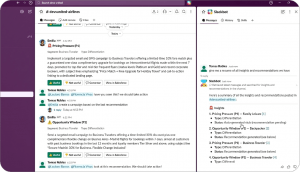
3. Recommendations delivered directly in Slack
The agent delivers findings straight into Slack with specific action items:
- Avoid price-focused messaging in the upcoming campaign for this segment.
- Pivot content toward value proposition and brand differentiation.
- Reduce message frequency to this segment during the week.
This is not just a report—it is proactive decision support delivered right inside the team’s workflow.
4. Creation of market-based segmentation attributes
The agent’s most innovative feature is converting market context into reusable segmentation attributes within Data 360. With a single click in Slack, the team can authorize the agent to create new parameters—such as “High Competitive Promotional Pressure”—making them instantly available for future campaign targeting. Over time, teams build a dynamic library of market attributes that go far beyond historical customer data.
How artificial intelligence enhances market intelligence
Artificial intelligence expands the reach of market intelligence by enabling organizations to process, connect, and interpret vast volumes of information with speed and contextual precision.
This significantly narrows the gap between detecting a market shift and executing a relevant response, while maintaining human oversight for strategic decisions.
Rather than building infrastructure from scratch, companies can leverage three core layers of the Salesforce ecosystem:
- Data 360 (Unified Data Layer): Unifies structured data (CRM, transactions, POS, e-commerce) and unstructured inputs (documents, surveys, emails, market reports) into a unified customer profile and market context. Zero-copy integration with platforms like Google BigQuery eliminates data duplication.
- Agentforce (Intelligence & Action Layer): Operating on the unified data, autonomous agents interpret signals, generate recommendations, and trigger actions—ranging from audience creation to campaign orchestration in Agentforce Marketing.
- Agentforce Marketing (Execution & Measurement Layer): The environment where agent recommendations become targeted campaigns, personalized customer journeys, and measurable business outcomes.
Connecting these layers is a continuous agent loop:
interpret → recommend → execute → measure
This minimizes manual intervention at every step.
Metrics and indicators for evaluating insights and decisions
Measuring market intelligence ensures that detected signals translate into timely decisions and tangible business results. Organizations should move beyond counting dashboards or connected sources to evaluate data quality, insight utility, team adoption, and operational impact.
1. Data Quality and Insights
A recommendation is only as good as its underlying data. Assess whether key sources are integrated, data refresh rates are sufficient, and insights accurately reflect market shifts.
- Integrated Source Coverage: Percentage of connected priority data sources (CRM, e-commerce, campaigns, surveys, NPS, and market reports).
- Data Latency: Time elapsed between a market signal occurring and its availability for analysis.
- Insight Accuracy: Share of AI findings validated by domain experts as correct, relevant, and actionable.
- False Positive Rate: Percentage of generated alerts that require no intervention or deliver no actionable value.
- Confidence Level: Classification rating assigned to recommendations based on source quality and signal convergence.
2. Adoption and Decision Speed
Market intelligence generates value only when teams apply insights to campaigns, customer journeys, or CX improvements.
- Recommendation Adoption Rate: Percentage of generated recommendations reviewed, approved, or implemented.
- Signal Response Time: Average time taken between receiving an insight and making a decision (act, discard, or request context).
- Activation Rate: Proportion of insights converted into direct actions (e.g., audience adjustment, message change).
- Signal-to-Action Time: Total duration from initial signal detection to final response execution.
- Attribute Reuse: How frequently market attributes are leveraged across subsequent campaigns and journeys.
3. Governance and Continuous Improvement
Organizations must track the safety and precision of AI-assisted workflows to ensure oversight and control while scaling.
- Monitoring human validation rates, corrected actions, privacy compliance, and model accuracy over time.
4. Metrics Summary Matrix
To facilitate the visualization of the indicators, the following table summarizes key evaluation areas, what each measures, and the metrics that can be used to monitor the impact of market intelligence on business decisions.
| Evaluation Area | What it Measures | Key Metrics |
|---|---|---|
| Data Quality & Insights | Source completeness, recency, and signal reliability. | Integrated source coverage, data latency, insight accuracy, false positive rate, confidence levels. |
| Adoption & Decision Speed | How quickly teams adopt and act on generated insights. | Recommendation adoption rate, signal response time, activation rate, signal-to-action time, attribute reuse. |
| Marketing Impact | Whether market-informed actions improve campaign outcomes. | Incremental conversions, open/click rates, engagement, churn reduction, segment revenue. |
| Sales & Service Impact | How market context improves lead prioritization and CX. | Qualified opportunities, resolution time, customer satisfaction (CSAT), repurchase rates, LTV. |
| Governance & Quality | Precision, safety, and human oversight of AI workflows. | Human validation rates, override frequency, privacy compliance, model drift accuracy over time. |
Lessons from real-world enterprise implementations
Devs United is a Salesforce Summit Partner specializing in end-to-end platform implementations across Latin America and the United States. With over 50 certified consultants, we have partnered with enterprises such as LATAM Airlines, Walmart, Falabella, Scotiabank, Aeroméxico, Grupo Delosi, and C&A, maintaining an AppExchange rating above 4.85/5.
From these deployments, we highlight three key takeaways for organizations implementing market intelligence:
- Unstructured data is your largest underutilized asset: Companies invest heavily in brand studies, NPS surveys, and market reports that end up buried in shared drives. Tools like Data 360 and Agentforce activate this knowledge, turning static PDFs into live inputs that inform daily campaign decisions.
- Adoption skyrockets when AI works where teams already operate: Forcing teams onto a new dashboard creates friction. Adoption accelerates when agents deliver insights inside existing workflows—Slack, Teams, email, or directly within Agentforce Marketing.
- Start small to demonstrate quick wins: You don’t need to integrate every data source on day one. Begin with a single use case, category, or region. Delivering measurable ROI in weeks rather than months builds the internal buy-in needed to scale across the enterprise.
The modern marketer doesn’t work with less data—they work with better signals
The promise of market intelligence isn’t to oversimplify market complexity, but to make it actionable in real time. Marketers remain the ultimate decision-makers, but they act with a level of context that was previously impossible to achieve without weeks of manual labor.
Teams adopting these capabilities won’t just optimize campaign performance—they will build a compounding intelligence advantage that drives long-term market leadership.
What is the next step?
Market intelligence is key to achieving a true 360° customer view. Platforms like Salesforce Data 360 and Agentforce bring real-time insights within reach, but unifying scattered, multi-format data remains a major challenge.
That’s where Emilia comes in. Our production-ready Market Intelligence agent integrates structured CRM data with unstructured market insights—transforming raw signals into actionable strategies that deliver measurable results and drive your business forward.
Ready to turn market insights into your competitive advantage? Schedule a demo today and see Emilia in action
